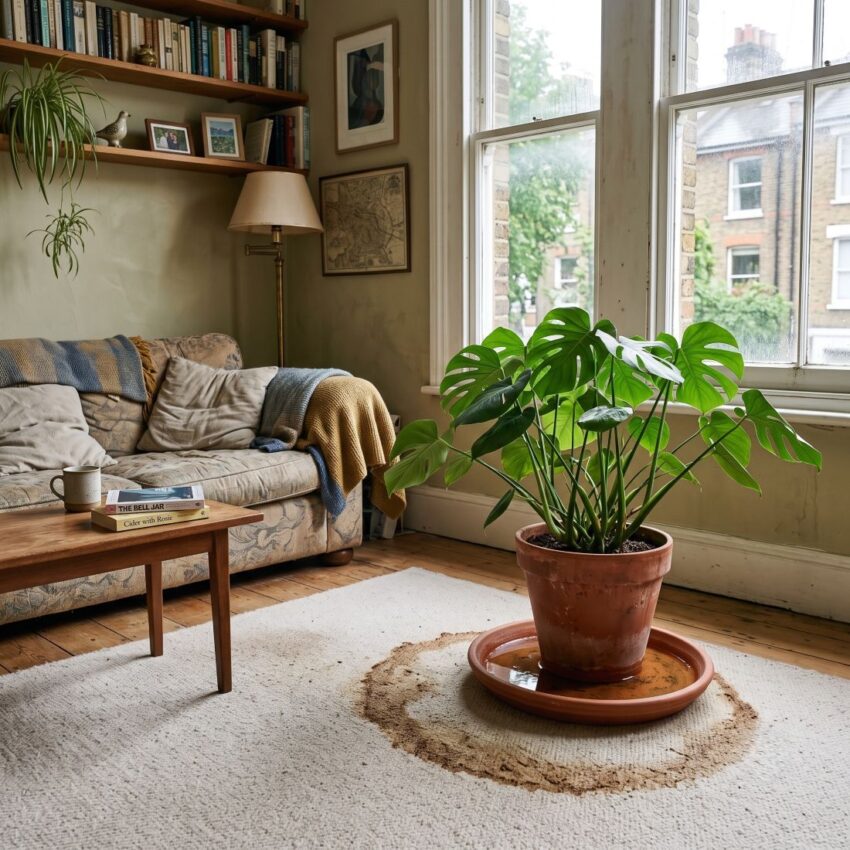
A knocked or overfilled plant pot does two different kinds of damage at once, and people almost always deal with the wrong one first. There’s the mess you can see — wet compost spread across the pile, a brown tidemark creeping outward. And there’s the pint or so of water that has already gone straight down through the carpet into the underlay, where you can’t see it and won’t easily get it out.
The visible mess is the one that gets all the attention. It’s the other one that ruins carpets.
What’s actually gone wrong when a plant pot leaks into the carpet?
Two things, on two different levels.
On top, you’ve got soil. Potting compost is a mix of fine silt, peat or coir, bark, and whatever fertiliser was worked into it, and when it’s wet it behaves like thin mud. Press on it and it spreads. Rub it and it drives down into the pile and paints a wide brown halo where there was a neat little heap. The colour you see is more than dirt: it’s organic matter and tannins leaching out of the compost, plus any plant food that was in the mix, and those leave marks of their own that ordinary dirt doesn’t.
Underneath, you’ve got water. A pot that’s tipped or overflowed puts out far more liquid than the surface can hold, and gravity takes the rest down through the backing into the underlay and, on a suspended timber floor, potentially into the boards below. That water sits. A carpet pile can feel dry to the hand within a day while the foam or felt underlay beneath it stays wet for a week, in the dark, with no airflow — which is the exact condition mould asks for.
Why the water matters more than the stain
The stain is almost never the emergency. The water is.
A soil mark on the surface is cosmetic and, nine times in ten, recoverable with patience. Trapped water is structural. Left in an underlay in a still, warm corner — behind a plant stand, or in a ground-floor flat that never quite airs out — it turns to mould and sour odour within days, and no amount of scrubbing the top will touch it, because the problem isn’t up there. Deal with the water fast and you’ll usually save the carpet. Fuss over the brown mark while the underlay quietly stays soaked and you can lose the lot.
Should you clean the stain straight away or let it dry first?
Get the water out straight away. Leave the mud well alone until it’s bone dry. Those two instructions feel contradictory, and they’re the whole trick to this.
What to do in the first ten minutes
Move the pot and its saucer right off the carpet — not to one side, off it — before anything else. Scoop up the solid compost with a spoon or a blunt edge, lifting it away rather than pressing down. Then lay a thick towel over the wet patch and stand on it, or press hard with the flat of your hand, to draw as much water up out of the pile and backing as you can. A wet-and-dry vacuum, if you own one, is far better here than any towel. Get airflow going — a window open, a fan pointed at the spot.
Then stop. Do not attack the residual soil while it’s wet.
This is where most people go wrong, and it’s why a saucer-sized accident so often ends up a dinner-plate stain. Wet compost smeared with a cloth doesn’t lift — it spreads sideways and sinks down, and every pass makes the affected area bigger and the mark deeper. Dried soil, by contrast, mostly turns back into loose crumb that a vacuum pulls straight out. So be patient: get the water up, then leave what’s left to dry completely, even if that takes a day.
One caution while it dries: keep heat off it. A radiator shoved up close or a hairdryer on full can bake organic staining permanently into the fibre and cook a faint smell into a fixed one. Moving air at room temperature dries a carpet perfectly well — it just wants time rather than force.
How do you get the dried soil and the brown mark out of the pile?
Vacuum first, and vacuum properly. A surprising share of a dried compost spill comes away as dry particulate the moment the pile is stiff enough to release it. Go over it several times, slowly, from different directions, before a drop of anything wet goes near it.
What’s left after that is the actual stain, and it wants a gentle hand. A mild carpet-cleaning solution or a weak washing-up-liquid dilution, applied to a cloth and blotted from the outside of the mark inward, will lift most ordinary organic soiling. Blot and lift with a clean part of the cloth each time. Resist soaking it — you’ve just spent a day drying this carpet out, and there’s no sense putting the water back in.
Why plant food and terracotta leave their own marks
Two things in a plant pot aren’t ordinary dirt and don’t always come out with ordinary cleaning. The first is fertiliser. Plant food is largely mineral salt, and when the water carrying it evaporates it can leave a pale, faintly crusty ring that draws damp back to itself in humid weather. The second is the pot. Unglazed terracotta is porous, and the minerals in London’s hard tap water move through it and into whatever it’s standing on — over months, that shows up as a faint rusty or yellowish tint in the pile directly under the pot, a mineral tint rather than a dirt one, and it needs a specialist spotter rather than elbow grease. If a mark won’t budge and it’s the colour of weak tea or rust, that’s usually what you’re looking at.
What happens to the water you can’t see — and why does the carpet smell weeks later?
This is the part that decides whether the carpet lives or dies.
An underlay behaves like a sponge laid under the floor. It draws water in readily and gives it up slowly, and because it’s sealed under the carpet with a wall or a heavy pot on top, it has almost no way to dry on its own. The surface fools you. You blot the pile, it feels dry by the evening, you assume the job’s done — and the litre that went through to the underlay just sits there in the dark, warm and undisturbed, for the best part of a week or more.
That’s a breeding ground. Within a few days you get bacterial and fungal growth, and with it the sour, faintly mushroomy smell that so many people describe and so few can locate. They clean the carpet surface again and again and the smell keeps coming back, because the source is underneath, in the wet, where surface cleaning can’t reach it.
And it travels further than the mark suggests. Water in an underlay wicks outward along the path of least resistance, following the floor rather than staying put, so the wet area beneath is routinely two or three times the size of the brown ring you can see on top. A tea-plate stain can sit above a dinner-plate of soaked underlay. That gap is the single reason a spill that looks trivial is worth taking seriously — the visible evidence understates the real footprint every time.
Worse than the smell, over time, is what damp does to the carpet’s construction. Most carpet is two layers of backing held together with a latex adhesive, and prolonged wetting breaks that bond down. The carpet goes stiff and crunchy underfoot, then starts to ripple and lift as the layers separate — delamination — and at that point a patch has to be replaced, not cleaned.
I was called to a garden flat off Lordship Lane in East Dulwich last spring where none of this had been a single dramatic spill. A big fiddle-leaf fig in an unglazed terracotta pot had been weeping slowly through its base onto the carpet for weeks, a dribble at a time, and nobody had thought to move it. By the time anyone noticed, the pile under the pot had gone soft and dark and the whole corner smelt of mushrooms. The stain itself was nothing. The underlay was ruined, and a square metre of it had to come up and out. A one-off spill dried properly would have been a non-event. It was the sitting that did the damage.
Why does the carpet smell musty again after you’ve cleaned it?
Because the smell is living growth in a wet underlay rather than a stain in the pile. Every surface clean removes nothing that’s causing it. The only fix is to dry the structure out completely and treat what’s grown, and if the underlay has been wet long enough, to take it up.
When is it a job for a professional?
When a lot of water went in, when it’s been wet more than a day or two, when there’s any smell at all, or when it’s a ground-floor or timber-floored room where damp has somewhere worse to go.
The rule of thumb is simple: the longer water has been in the floor, the less a surface clean can do and the more the whole structure needs drying out. A fresh spill you caught within the hour is usually a job you can finish yourself. A spill you found a week later, or a slow leak like the fig, has almost certainly moved past that point.
What can a carpet cleaner do that a towel can’t?
Measure, extract, and dry — properly, and to depth. A moisture meter shows how far the water actually spread, which is almost always further than the visible mark. Extraction equipment pulls water out of the backing and underlay that no towel will ever reach. Air movers dry the structure from below rather than just the surface, and an antimicrobial treatment deals with anything that’s started to grow while it was wet. If delamination has set in, that section gets lifted and replaced rather than pretended over.
A spilt pot is not, in itself, a disaster. The disaster is the week it spends sitting in the underlay while everyone stares at the mark on top.